
Why most AI projects fail before they start.
Most companies don’t fail at AI because the technology is hard, they fail before they start. Are you actually ready for AI?


Read this newsletter in your own language? Open it in your browser https://andrsprojects.substack.com/p/why-most-ai-projects-fail-before and use your browser’s translation settings:

Why do AI projects fail?
In a lot of companies this is happening: someone has tried something with AI, it didn’t quite match up to expectations, and was quietly filed under “not for us yet.”
It’s a failed pilot that never got a second chance. The tool that got bought and never opened. The team that waited for a strategy that never came. If AI isn’t a top management priority, a company’s AI initiatives will be initialized by the companies’ intrapreneurs and early adopters from the ground up, but fail without the pushing power or support that is needed to bring it past middle management layers.
The “AI readiness” gap in most companies
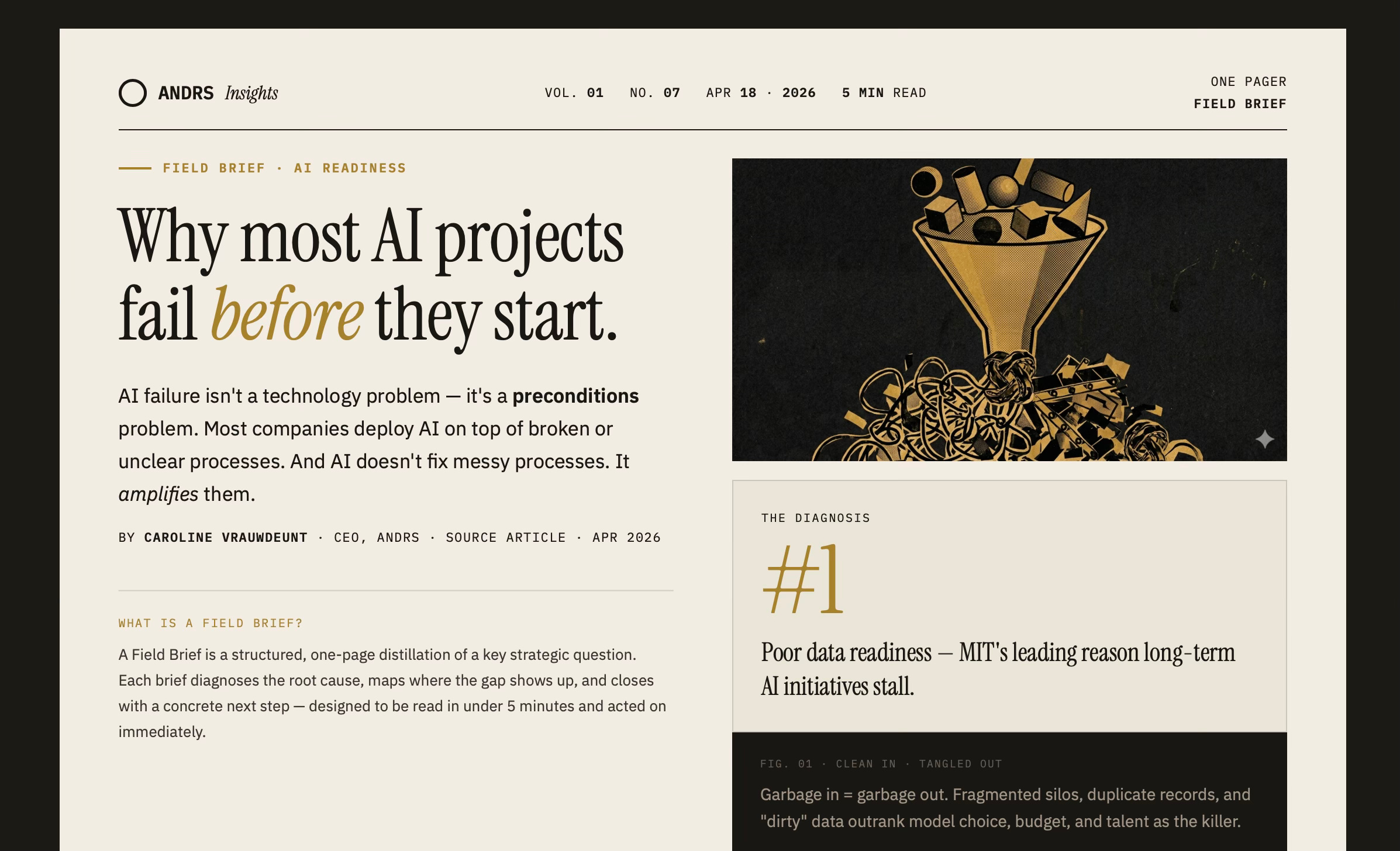
AI failure isn’t a technology problem, it’s a preconditions problem. Most companies try to deploy AI on top of broken or unclear processes and AI doesn’t fix messy processes, it amplifies them.
The readiness gap shows up in four places:
Data: No clean, accessible information for AI to work with. Garbage in = garbage out. Fragmented data silos, duplicate records, and “dirty” data plague projects. Research by MIT and industry experts identifies poor data readiness as the #1 reason long-term AI initiatives stall.
Process: No clear owner, no defined workflow, no baseline to measure against. Who calls it successful enough to implement (and where) and what is success measured against. Many companies begin AI initiatives focusing on the wrong questions. Instead of starting with a concrete pain point and defining success metrics, they rush to deploy tools and ask “what can AI do for us?”
Mindset: Companies that do succeed with AI treat it as an organizational capability — one that needs sponsorship, ownership, and iteration. Not a tool you buy and activate. The tell: an enthusiastic early adopter gets something working, and it stalls at middle management. Not because the tool failed, but because there was no mandate and no guts to push it through.
Expectations: The AI zeitgeist has often unrealistically emphasized transformative potential while glossing over the complexity of execution. When executives embark on AI projects “with only a high-level goal and a belief in miracles” they expect technologies that require months of dataset preparation or model retraining to pay off immediately.
Tool: ChatGPT + Custom Instructions
Custom instructions are the most underused feature in ChatGPT. And the gap between someone using raw ChatGPT and someone who’s set up proper context is enormous. It’s essentially a way to give ChatGPT a standing context about who you are and what your project is about, so it doesn’t start from scratch every conversation.
Go to Settings → Personalization → Custom Instructions. In the first box, describe yourself: your role, your industry, how you work. In the second, tell it how to respond: tone, length, format. Two minutes of setup. Every conversation after that starts with context.
If you're working on a specific project, the setup works slightly differently:
Create a Project → Tap the three dots in the right hand corner of the project page → Add Project information and Custom Instructions. Every conversation in the project folder after that starts with context.
The Move
Before touching any AI tool this month, spend 15 minutes answering three questions:
What’s the process I want AI to help with? Who owns it? What does “better” look like?
If you can’t answer all three, the tool won’t help. If you can, you’re already ahead of most companies.
From the Field: Embrace an innovation culture
IBM’s story serves as a masterclass for culture and mindset. The company, once a stagnant giant, redefined itself by fostering a risk-taking culture, challenging outdated ideas, and prioritizing customer needs over rigid processes.
1. Embrace a Risk-Taking Culture
Instead of punishing failure, IBM created an environment where experimentation was welcomed, allowing for breakthroughs that would have otherwise been stifled by excessive caution. No pilots, but implementation and iteration.
2. Implement a ‘No Fault’ Policy
A key part of IBM’s cultural shift was eliminating fear around making mistakes. They now acknowledge that errors are part of the learning process, promoting a ‘No Fault’ policy that encourages initiative and continuous improvement.
Implementing AI in your business is as much a company culture challenge as it is a technical one. Most companies I’ve talked to go straight to “which tool?” without asking whether AI is even the right solution category. They’re solving for tool selection when the real question is problem definition and whether your company culture is ready for it.
Want to see if you and your company are ready?
Start your free AI scan at consultancy.andrs.nu
Caroline Vrauwdeunt
CEO and founder of

Articles used to write this newsletter:
https://mlq.ai/media/quarterly_decks/v0.1_State_of_AI_in_Business_2025_Report.pdf
https://www.ibm.com/think/insights/failing-fast-traditional-strategy-and-how-they-work-together
https://robdthomas.medium.com/suggesting-a-pilot-is-a-weakness-d34ef58436aa
https://intuitionlabs.ai/articles/enterprise-ai-rollout-failures
View this edition in a field brief at andrs.nu/insights
Very interesting read , I think some companies need one visible win before leadership takes it seriously. The pilot just has to be the right one.